Both X-type folding house and Z-type folding house are foldable temporary or mobile buildings, but they have obvious differences in working principles and folding methods.
| Comparison Dimension | X-type folding room | Z-shaped folding room |
| Core Principles | Adopting scissor-type (X-shaped) folding structure, the whole folding is achieved by folding the cross rods. | Using a combination of slide rails and pulleys, the wall slides on the rails and folds in a Z shape between the top and bottom plates. |
| Folding form | Like an accordion, the whole body contracts synchronously, and the side wall panels are folded and stored between the top and bottom panels. | The side wall is divided into upper and lower parts, which are stored in a Z-shape on the surface of the bottom frame by sliding and rotating. |
| Expansion method | The top plate can be lifted as a whole by hoisting equipment and quickly deployed | Push the side wall panel to slide along the rail and lock it. |
| Structural characteristics | The structure is relatively uniform, relying on the strength and precision of the hinge points | Depends on the stability and durability of the slide system, and has high requirements for manufacturing technology |
| Transport stacking | The structure is compact after folding, and the specially designed lifting parts and connecting parts help to stabilize the stacking | After folding, it is flat, and when multiple boxes are stacked, the center of gravity is low, which is convenient for transportation |
| Typical Applications | Campsites, campsites, and other scenarios that require rapid deployment | Temporary buildings at construction sites, makeshift hospitals, and other emergency housing scenarios that require rapid turnover |
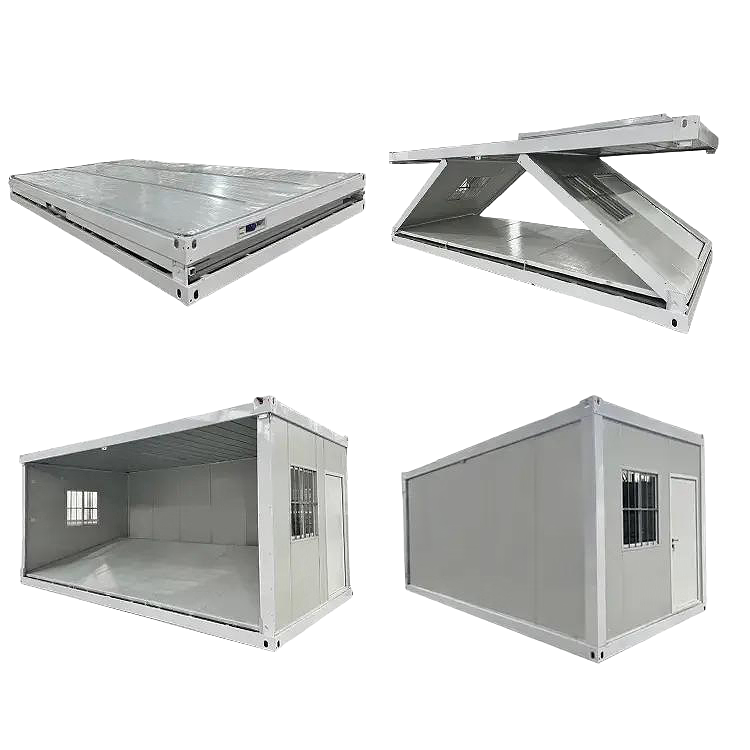 Z-type folding house |
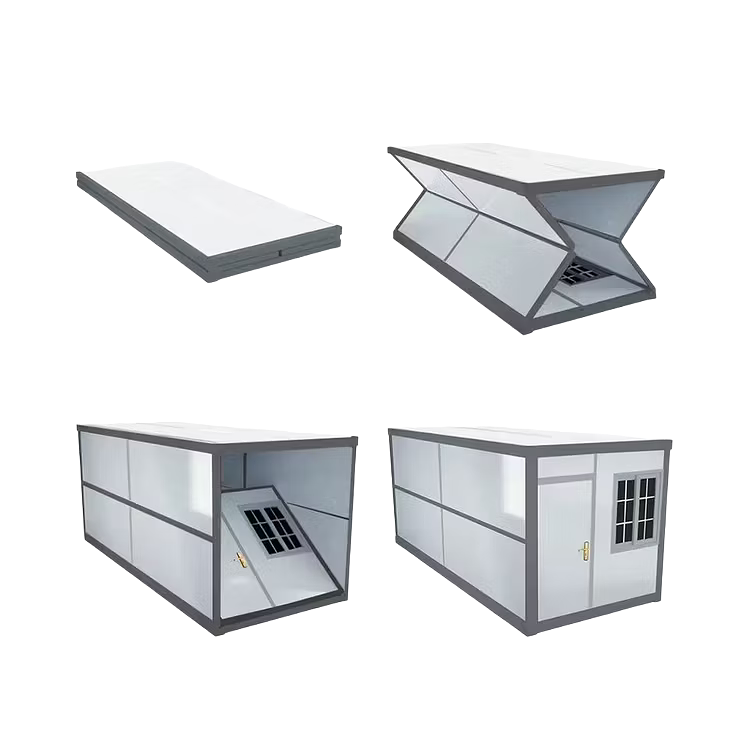 X-type folding house |
Think of it this way:
X-fold: Like opening a traditional toolbox, the lid (top panel) lifts up, and the two side supports (X brackets) expand, securing the structure.
Z-fold: Like opening an accordion or an old-fashioned folding lantern, this is achieved by sequentially unfolding the joints.
Summary:
The X-type folding room emphasizes structural rigidity and long-term durability, making it suitable for construction site dormitories or employee housing where stable support is required.
The Z-type folding room focuses on quick construction, convenient transportation, and compact space, making it more suitable for scenarios requiring rapid deployment, such as emergency response, temporary offices, and campsites.

